How might legibility by design, enabled through shared system records, reshape trust, responsibility, and decision-making in housing systems?
2020-2022 · Urban Informatics Research ·Group Project with Team TDIS, NYCU
Lab: Transdisciplinary Design Innovation Shop (TDIS)
Advisor committee: Sheng-Kai Tseng, June-Hao Hou, Si-Min Lee
My role: Socio-Technical Systems Design, System Architecture & Viability Modeling
During my undergraduate studies at NYCU, I spent two years conducting research in the Transdisciplinary Design Innovation Shop (TDIS), where I worked at the intersection of urban systems, policy, and design research. Through this work, I became interested in how urban challenges are shaped not only by spatial constraints, but by fragmented information, institutional responsibilities, and long-term policy goals.
Our team was selected to represent NYCU in Solar Decathlon Europe 21/22, an international student competition that frames housing as a deployable socio-technical system rather than a purely architectural artifact. In alignment with the competition’s core objectives, we developed a policy-oriented system proposal addressing housing affordability, viability, and deployability, evaluating whether the system could realistically be implemented within economic and infrastructural constraints.
My role focused on infrastructure system design and affordability and viability analysis. I modeled how the housing system could operate under real-world constraints by examining cost structures, resource flows, stakeholder responsibilities, and implementation feasibility, ensuring that the proposal remained credible as a pathway rather than a speculative concept. I also aligned this deployability logic with long-term policy direction, framing how the system could plausibly support EU net-zero targets by 2045 while meeting public-sector requirements for both sustainability outcomes and economic viability.
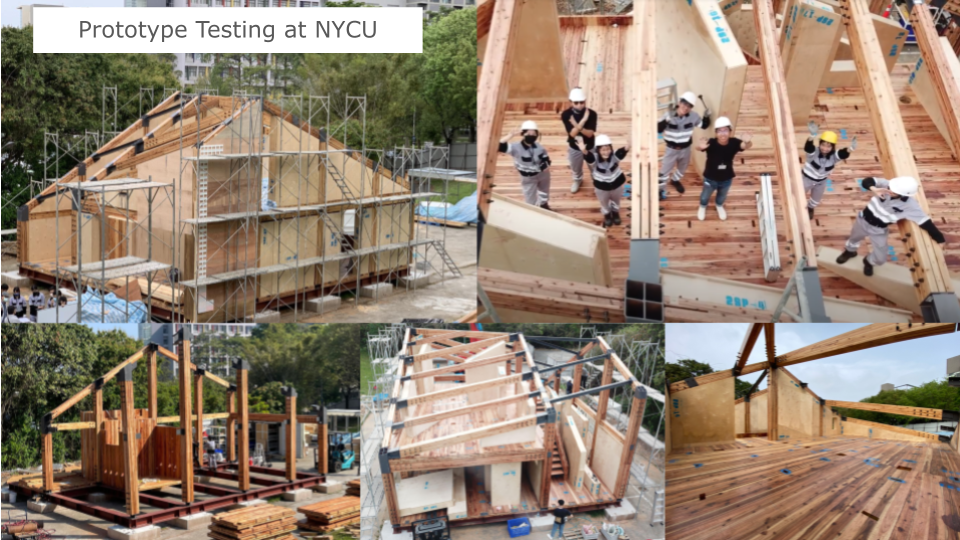
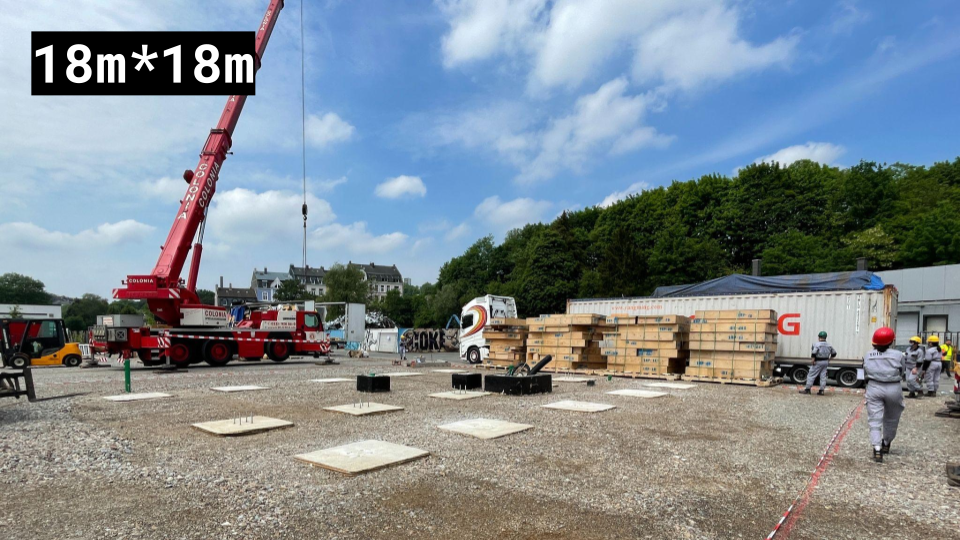
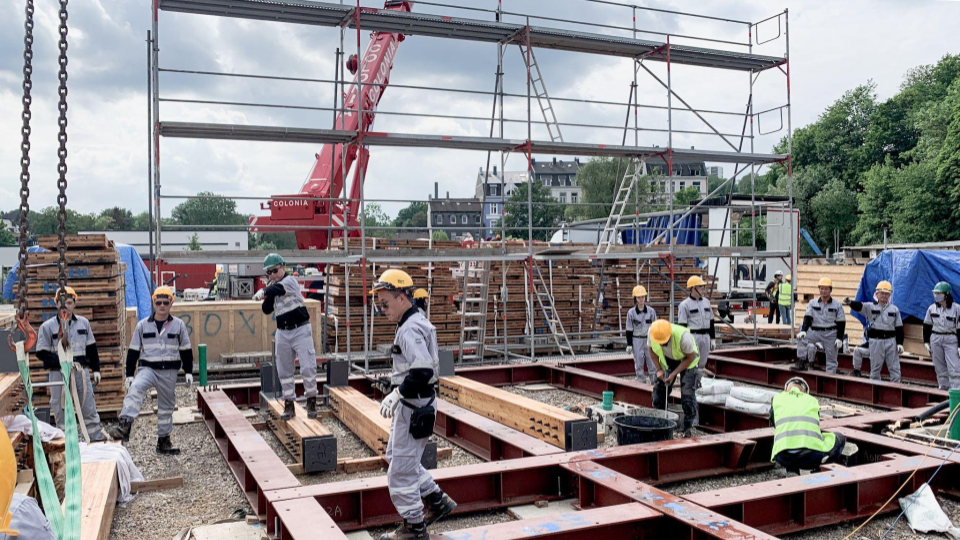
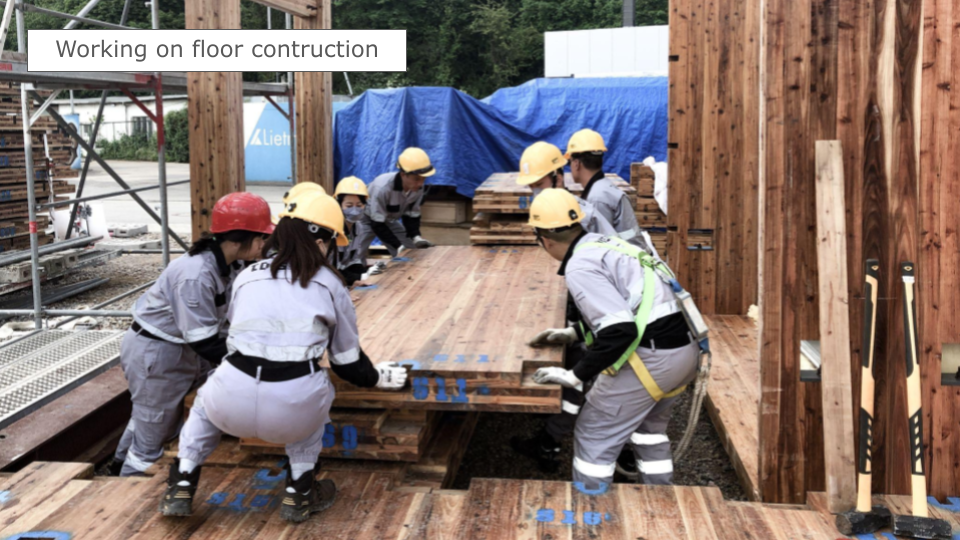
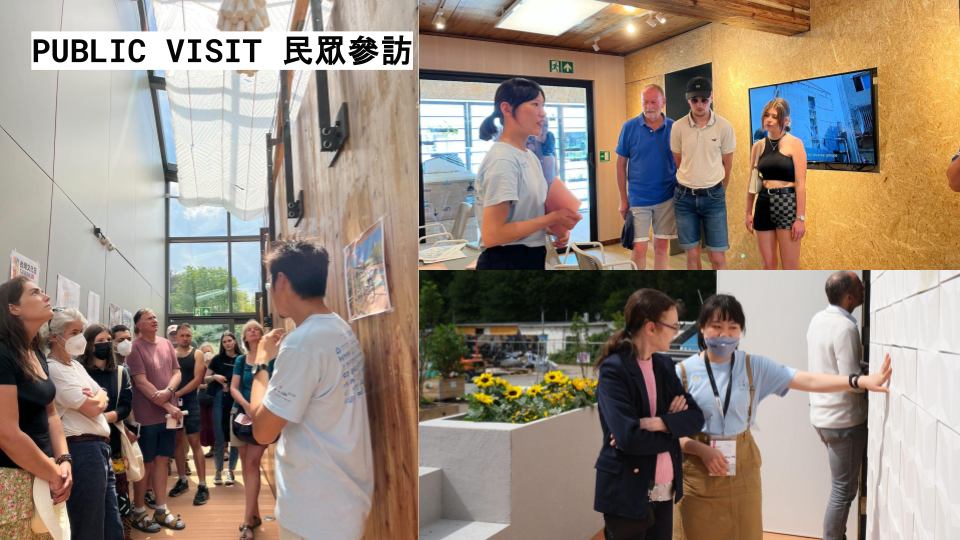
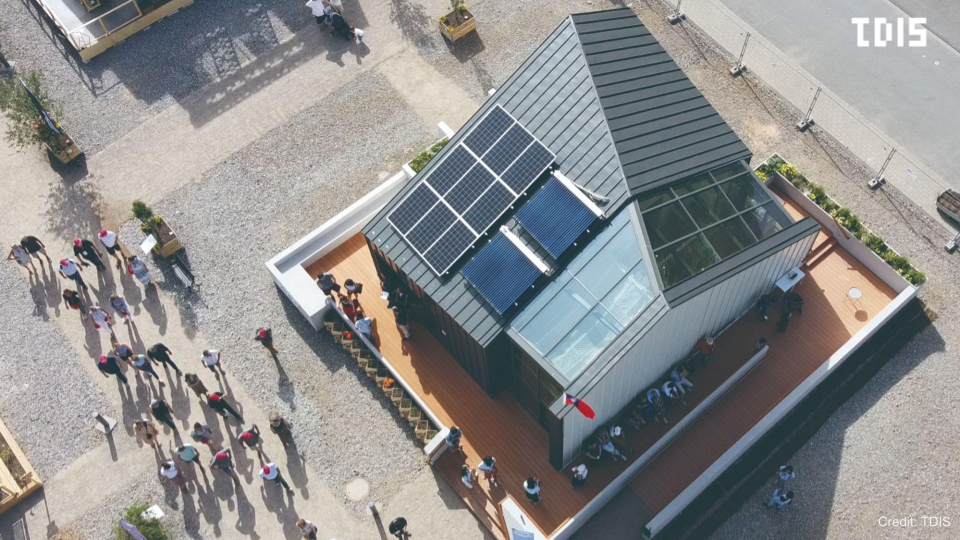
Within this framework, our team developed a socio-technical housing system grounded in urban housing challenges in Taipei, Taiwan. To evaluate its deployability, we constructed a full-scale housing prototype in Wuppertal, Germany. The project was awarded First Place in Architectural Design and Third Place in Innovation Design, and was later selected to operate as a living lab at University of Wuppertal, supporting ongoing study and evaluation.
Taipei faces escalating housing unaffordability, urban loneliness, and stagnated urban regeneration due to information asymmetry within the housing system, which undermines trust and coordination between residents, landlords, and public agencies.
The core urban issue is not a lack of land, but a lack of mobilizable housing capacity caused by information asymmetry. So-called pocket lands reveal this gap: spaces that physically exist within the city, yet remain unused because the housing system cannot clearly determine how they can be allocated, managed, or governed.
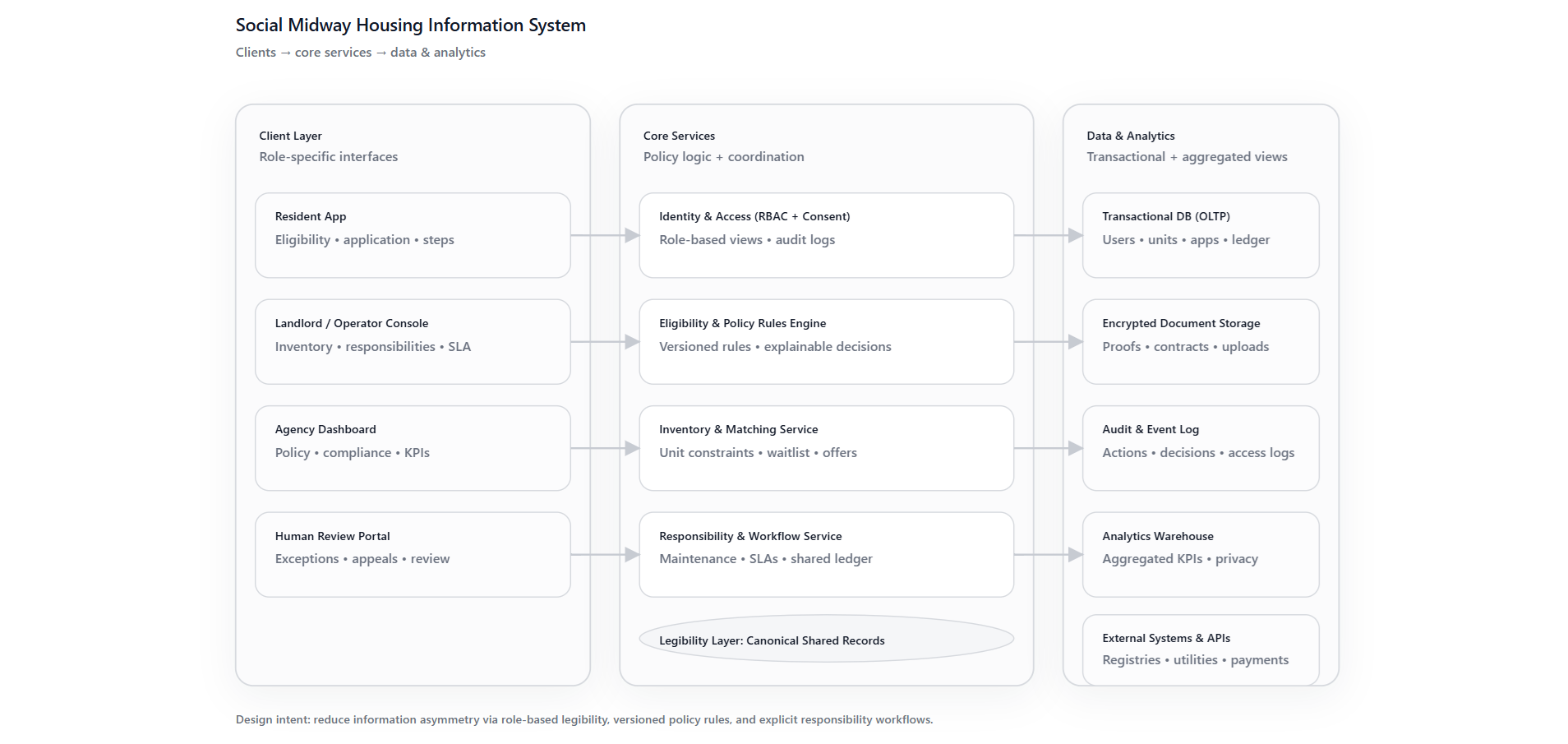
The following diagram presents the overall system architecture, outlining how residents, operators, and public agencies interact with a shared information infrastructure. It illustrates the separation between client-facing interfaces, core coordination services, and underlying data and analytics layers—clarifying how policy logic, operational workflows, and evidence generation are structured within the system.
A layered information system connecting stakeholder interfaces, coordination services, and data infrastructure to reduce uncertainty and support deployable decision-making.
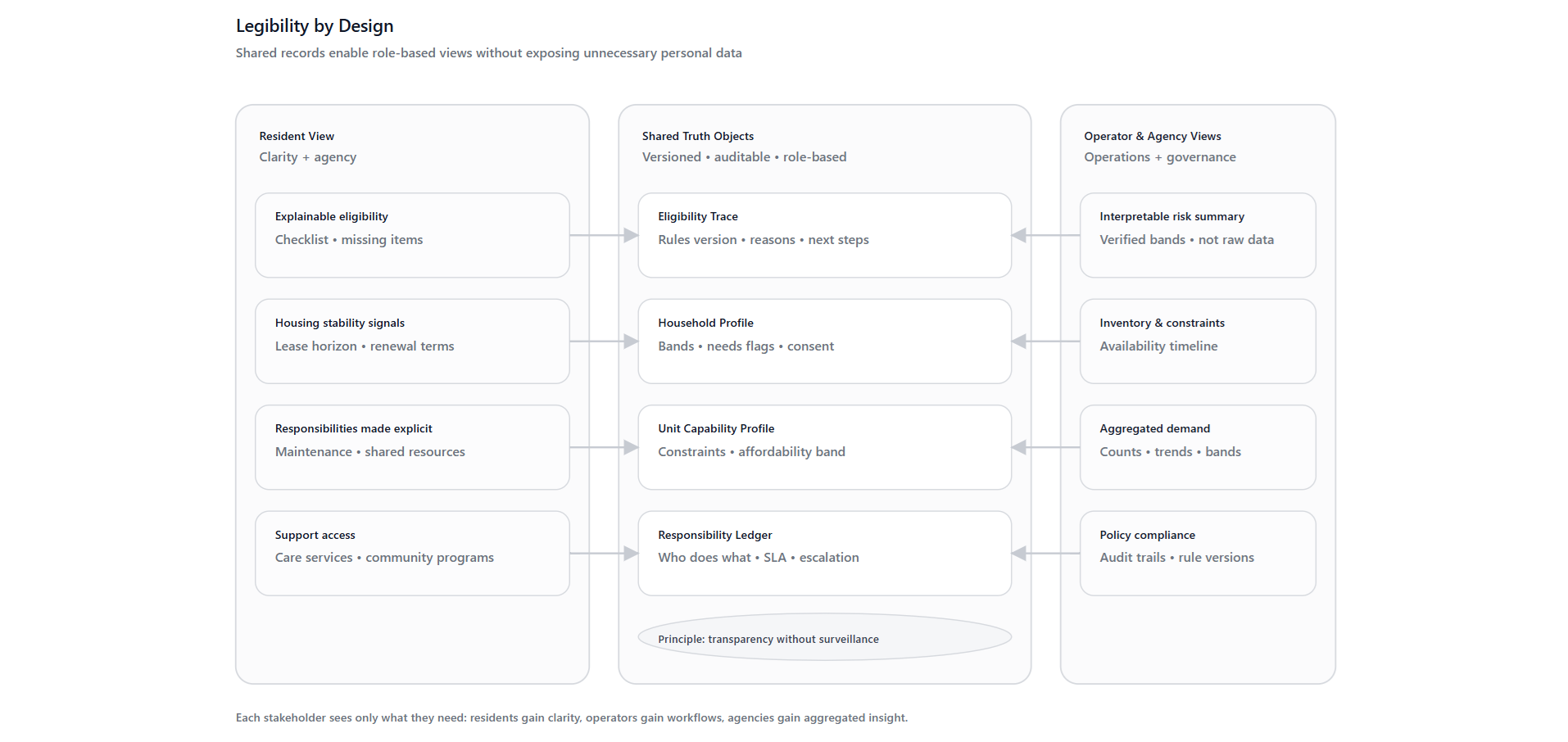
While the system architecture defines the components and data flows, effective deployment also depends on how information is made legible to different stakeholders. The following diagram illustrates how shared system records are structured to provide role-based visibility—allowing residents, operators, and public agencies to access the information they need without exposing unnecessary personal data.
Shared system records provide different stakeholder views—supporting transparency, coordination, and governance without surveillance.
While working on this project, I realized that many housing challenges were not caused by a lack of space or resources, but by a lack of legibility. Residents, landlords, and public agencies often make decisions based on partial or opaque information. My focus became designing how information is revealed among each entity.
Legibility became important in this sense. Certain elements needed to become explicit: whether someone is eligible, what a housing unit can realistically support, and who is responsible for maintenance, care, or shared resources. By formalizing these as shared system records, the project turns implicit assumptions into visible structures that people can reason about.
At the same time, I was careful about information disclosure. Residents need clarity and agency. Operators need interpretable summaries for coordination and risk. Public agencies need aggregated signals and auditability to evaluate outcomes, without direct access to personal records. Information is therefore presented at different levels of resolution, from actionable steps to abstracted trends.
For me, governance is not about surveillance, but about making systems understandable enough for trust and coordination to emerge. Designing legibility allowed the housing system to become more deployable, governable, and humane.
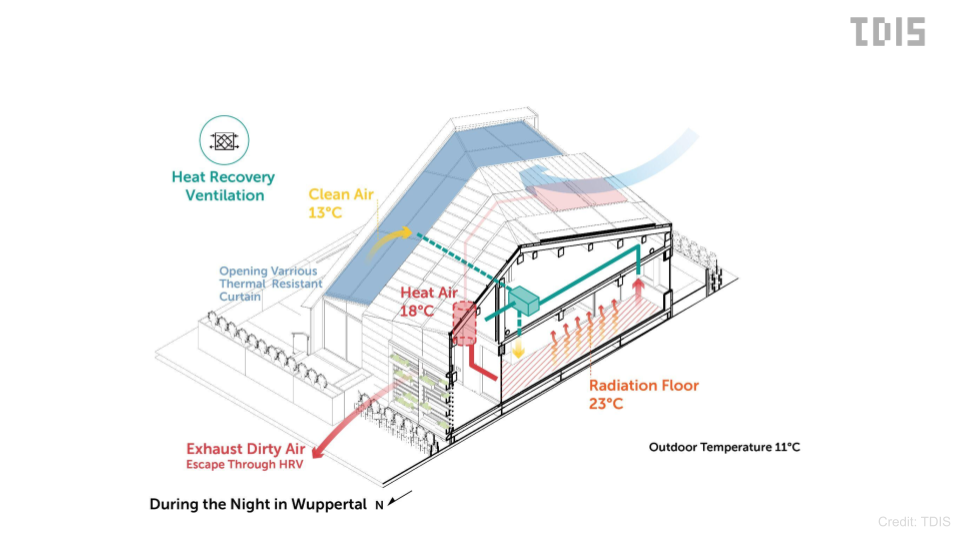
In evaluating the accessibility, viability, and affordability of this system, I closely examined the following aspects: Financial viability, energy efficiency, policy alignment, risk distribution in the infrastructure, and deployability test.
Financial viability and affordability
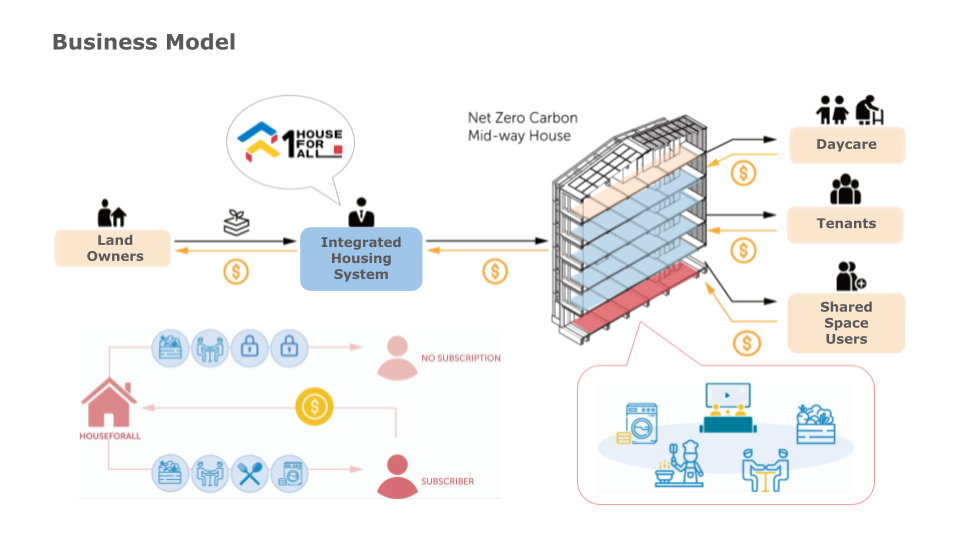
I developed a business and operational model for the social housing system, evaluating construction cost, long-term maintenance expenses, and income flow across different occupancy and subsidy scenarios. This analysis allowed the system to be assessed in an economically grounded way that could sustain itself over time.
Energy efficiency and policy alignment
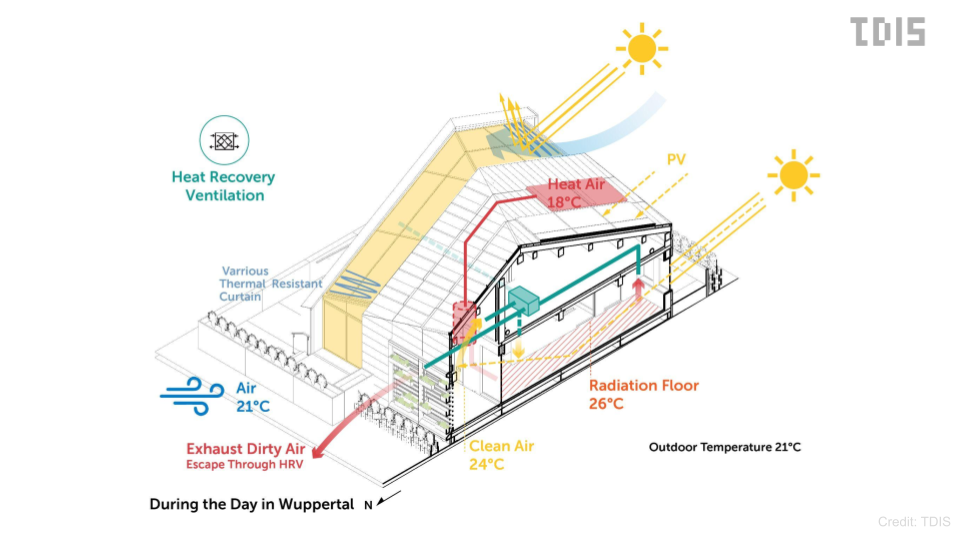
The financial model was closely tied to energy-efficient building strategies and policy incentives. By incorporating energy performance targets and anticipated reductions in operational cost, I evaluated how sustainability policies could directly support affordability and long-term viability, particularly in alignment with EU net-zero targets by 2045.
Risk distribution and responsibility clarity
The evaluation also examined how costs, risks, and responsibilities are distributed across stakeholders, including residents, operators, and public agencies. By making these relationships explicit, the system reduces financial uncertainty and helps public-sector decision-makers assess whether the model can be deployed at scale without disproportionate risk.
Deployability as evaluation
The construction of a full-scale prototype served as a validation of assumptions used in the financial and operational model, ensuring that construction methods, material choices, and maintenance logic aligned with the proposed system constraints. Through this evaluation framework, impact is defined not by short-term performance, but by whether the system can remain affordable, maintainable, and policy-compatible over time.
Developed as an urban system proposal, this project was evaluated across architectural, engineering, energy, affordability, viability, public education, and policy dimensions. This framing enabled institutional-level assessment of deployability, while suggesting future directions for exploring how system legibility is interpreted and negotiated in lived contexts.
The work also assumes a degree of cross-agency coordination and data standardization that may be difficult to achieve in practice. Future research could explore how governance structures and incentives shape the adoption of such information systems in fragmented urban contexts.
More broadly, the project raises questions about how much information should be made visible in public housing systems—and where the boundaries between transparency, accountability, and autonomy should be drawn. I see this work as a starting point for further research into how information design can support more humane and deployable urban systems.