Kamiplay
What is the smallest set of foldable units and connection rules required to produce open-ended spatial complexity through physical self-assem bly?
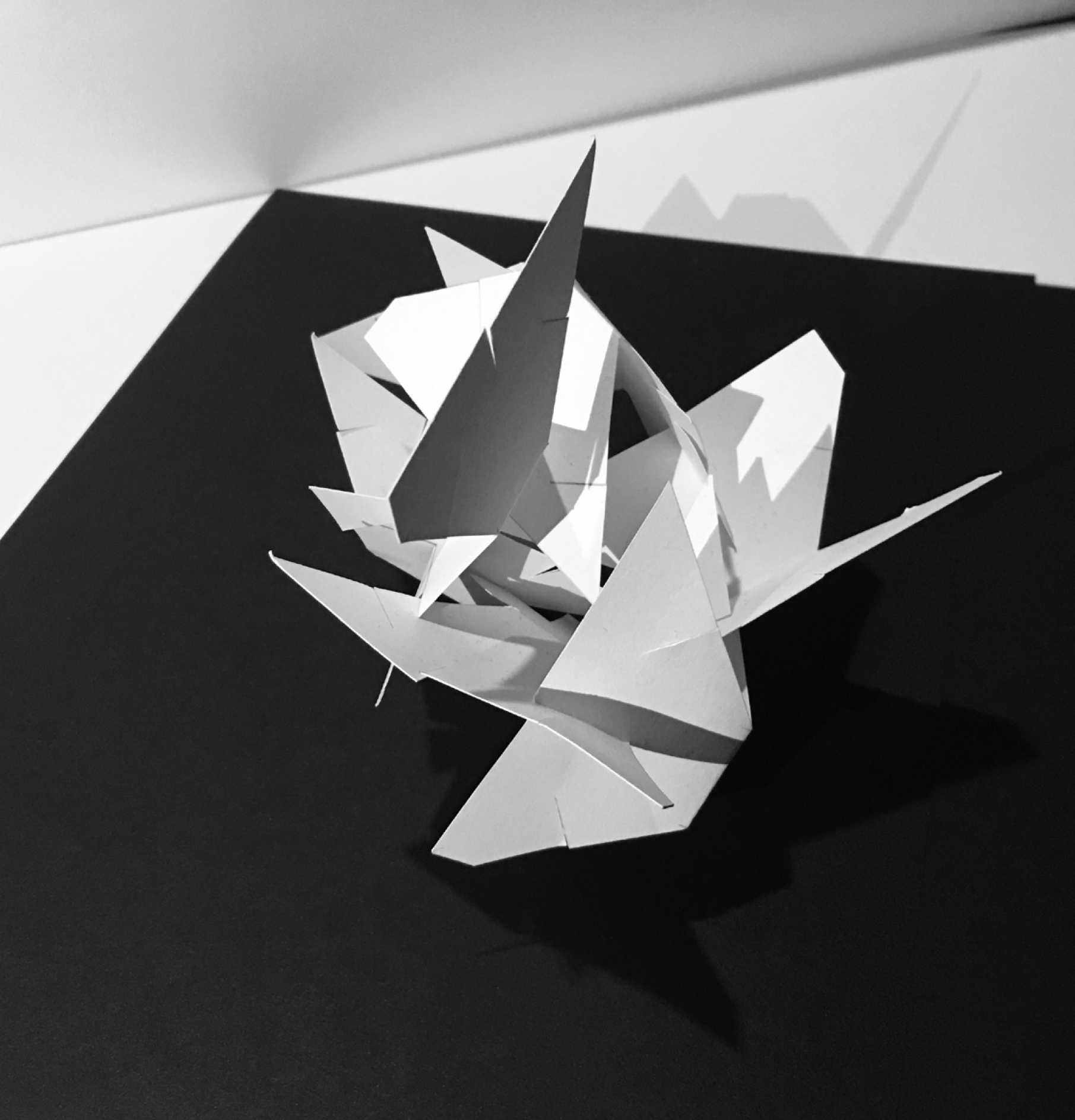
What is the smallest set of foldable units and connection rules required to produce open-ended spatial complexity through physical self-assem bly?
Kamiplay is a paper-based, deformable, modular toy system composed of three core units that enables open-ended geometric construction through play
Kamiplay explores play as a mode of inquiry into generative systems rather than as a means of achieving predefined outcomes. In play, par ticipants do not optimize toward a goal. Instead, they probe relation ships, test constraints, and discover structure through interaction. This project was developed within a course on exploratory toy systems, but it treats toys not as fixed instruments, but as open grammars through which complex behavior can emerge. The project embeds a minimal set of geometric and material rules into a small number of foldable units. Through folding, stacking, and recombination, players iteratively explore how spatial structures arise from these constraints. Rather than specifying final forms, Kamiplay defines a generative field in which outcomes are continuously negotiat ed between player action and material behavior. In this way, Kamiplay frames play as a physical form-finding process: a search through a space of possible structures, where complexity emerges from simple rules interacting over time.
This project explores how complex structures can emerge from simple units when rules are implicit rather than instructional. Drawing inspiration from origami, constructive play, and material-based learning, the research investigates how form, symmetry, and material behavior can guide exploration without explicit guidance. Paper was chosen as the primary material for its accessibility and transformability. While inherently flat and fragile, paper gains structural capacity through folding. This transformation allows the material itself to participate in the construction process, shaping outcomes through resistance, flexibility, and balance.
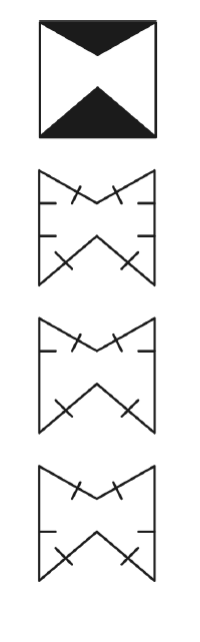
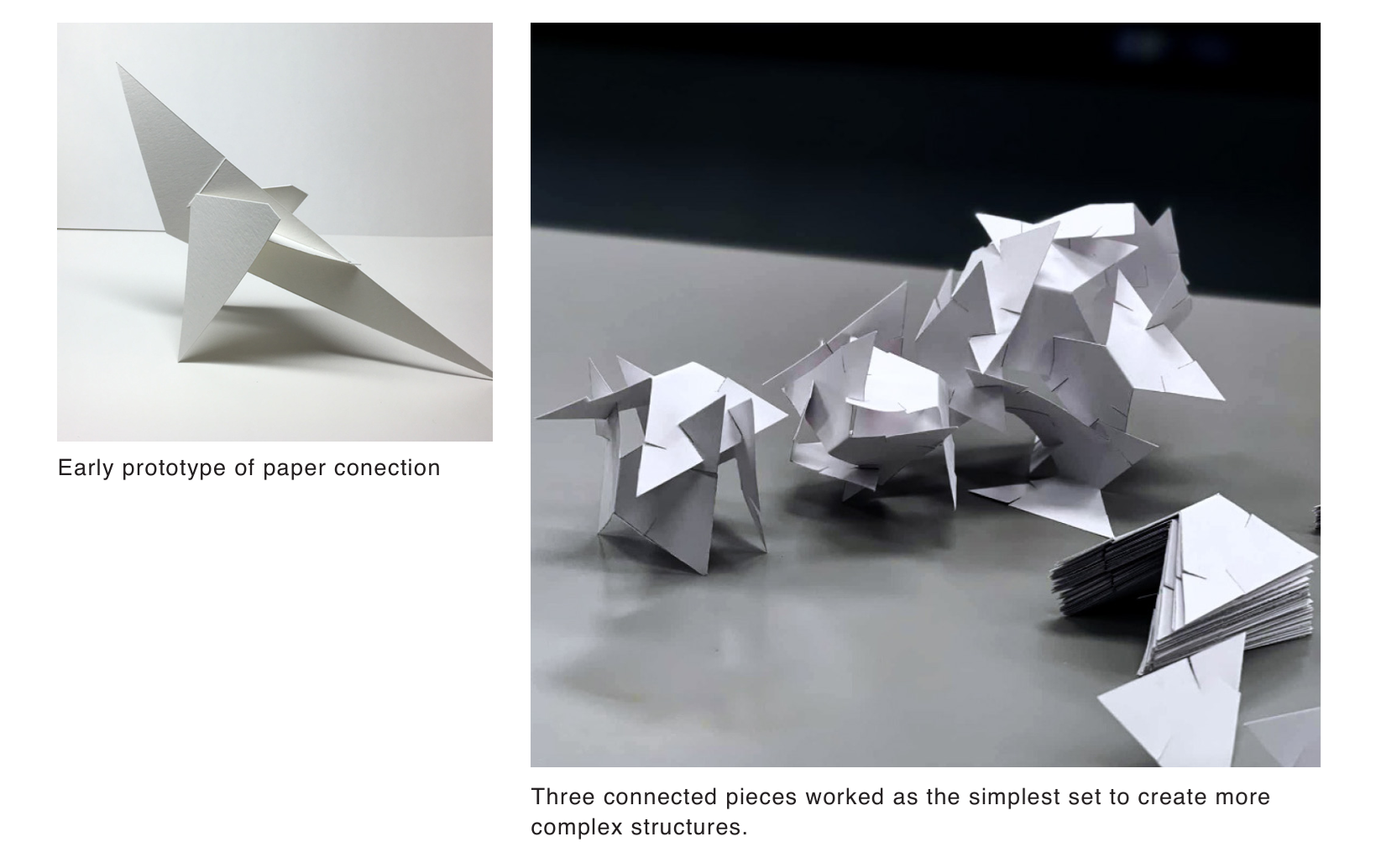
The Kamiplay system is composed of three connected basic units—the smallest viable set capable of generating a wide range of spatial configurations. Each unit is designed with bilateral symmetry. This allows constructions to resolve as either highly ordered or organically irregular, depending entirely on player intention. Crease placement within each unit introduces volume and structural tension, enabling flat components to become spatial elements through folding. By limiting formal complexity at the unit level, the system shifts expressive control to the act of construction itself. Geometry is not predefined but continuously negotiated through interaction.
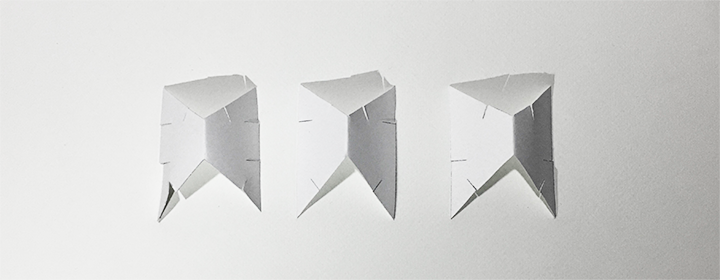
I selected 190 GSM paper to balance lightness with structural stability, allowing the system to remain flexible while supporting self-standing assemblies when stacked. The system is composed of three connected units, which is the smallest viable set capable of generating a wide range of spatial configurations. Each unit is designed with bilateral symmetry, enabling constructions to resolve as either highly ordered or organ ically irregular, depending on player intention. Crease placement within each unit is essential to introducing vol ume and structural tension, allowing flat components to transform into three-dimensional forms through folding.
The Kamiplay system is composed of three connected basic units—the smallest viable set capable of generating a wide range of spatial configurations. Each unit is designed with bilateral symmetry. This allows constructions to resolve as either highly ordered or organically irregular, depending entirely on player intention. Crease placement within each unit introduces volume and structural tension, enabling flat components to become spatial elements through folding. By limiting formal complexity at the unit level, the system shifts expressive control to the act of construction itself. Geometry is not predefined but continuously negotiated through interaction.
The project was tested with 12 participants engaged freely with the system without instructions or predefined goals. Through observation, two distinct modes of play emerged:
Some players actively searched for underlying structure and constraints within the system. They formed clear intentions early on and treated the toy as a representational tool. Their constructions were often highly symmetric and figurative, sometimes resembling creature-like or architectural forms. These players remained focused and deliberate, using the system to externalize a mental image
Other players engaged in a more spontaneous and intuitive manner. They built without a predetermined goal, responding directly to material behavior and emerging form. Their interaction was relaxed and iterative, resulting in abstract, irregular, and expressive structures.
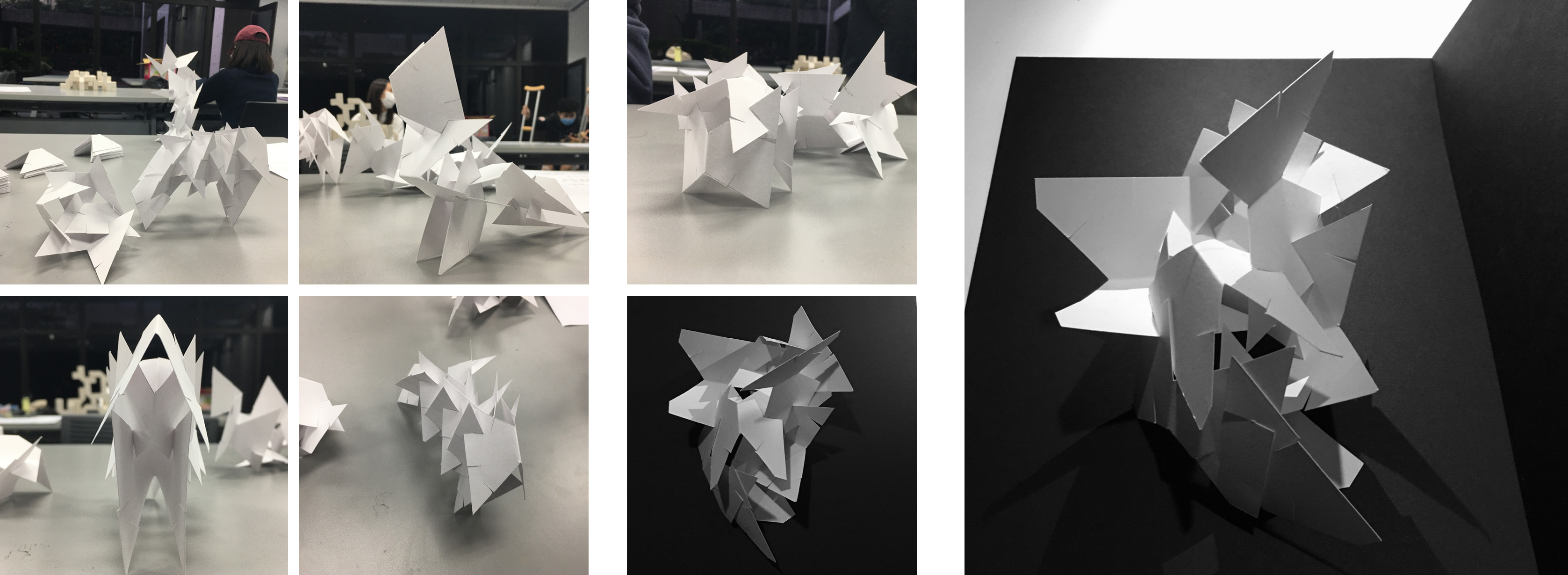
Kamiplay does not privilege one mode of play over the other. Instead, it reveals how different cognitive and behavioral tendencies surface when individuals interact with open systems.
The constructed forms function not only as physical out comes, but as traces of how players think, explore, and negotiate uncertainty. Through minimal rules and mate rial engagement, the project frames play as a method of inquiry—one that exposes patterns of reasoning, intention, and imagination.